Key context
A theme park is a complex spatial environment. It may cover dozens of hectares, contain scores of attractions, food venues, and performance spaces, and host thousands of guests simultaneously. The degree to which a guest can navigate this space comfortably, without frustration or disorientation, is partly a product of wayfinding design — and partly a product of narrative theming.
When theming is working well as an orientation system, guests may not experience it as wayfinding at all. They know roughly where they are because they are in a place that feels internally consistent — a medieval town, a jungle outpost, a fictional nation — and that consistency generates spatial memory. When theming breaks down, guests resort to maps, signage, and staff direction.
Orientation through environmental story
The claim that good theming reduces cognitive load for navigation is not always stated explicitly by park designers, but it is implicit in many design decisions. A zone with a consistent environmental identity — one that uses colour, material, sound, and lighting to reinforce a single atmospheric register — is easier to remember and locate than a zone that is merely functional.
Guests form spatial maps of park environments through movement, and those maps are enriched by narrative markers. A guest who has visited the zone with the lighthouse and the fishing boats will remember it differently from one who simply visited "area C." The narrative identity of a zone becomes a spatial address.
Landmarks and spatial anchors
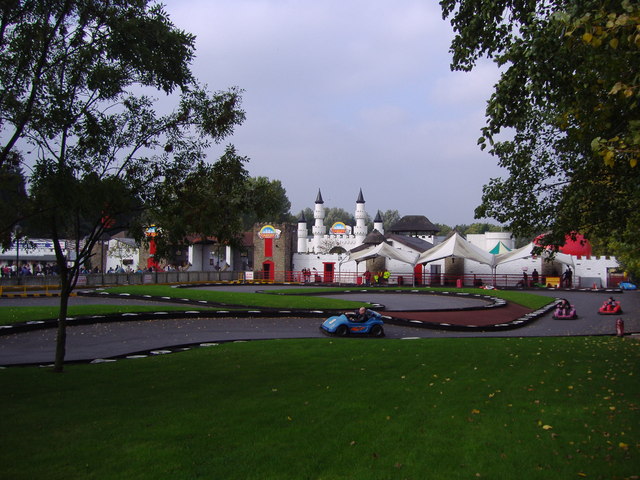
Tall structures — castle towers, mountains, visible rooflines — serve as visual anchors across large park areas. These landmarks help guests maintain a mental model of the park's geography because they remain visible from many positions. Parks that use central vertical landmarks (a real or artificial mountain, a landmark building) gain a significant orientation advantage: guests who become uncertain of their position can look for the known tall object and reestablish their spatial bearings.
The function of landmarks in immersive parks is doubled: they must serve both as orientation tools and as narrative objects. A mountain that anchors the geography of a park should also read, within the world of that park, as a mountain that belongs there — as something a fictional resident of that world would recognise and orientate by.
When signage becomes the story
Parks with strong thematic identities often integrate wayfinding into the narrative rather than overlaying functional signage onto a themed environment. Directional signs within a zone may use typefaces, materials, and language consistent with the zone's world — a park set in a historical European town might use painted wooden boards; a space-themed area might use illuminated panels in a fictional script.
This integration of wayfinding into theming requires maintenance discipline: a sign updated by a facilities team without design oversight can become a narrative intrusion, breaking the immersive surface with a contemporary typeface or an operational tone inconsistent with the zone's register.
Narrative coherence and legibility
The relationship between narrative coherence and spatial legibility is not simple. Parks that chase extreme coherence — eliminating every element that could undermine the fictional world — may create environments that are intensely immersive but also disorienting, particularly for first-time visitors who have not yet formed a mental model of the space.
Some degree of narrative "porosity" — places where the real world shows through, where operational necessity is visible, where standard contemporary wayfinding is used — may support spatial legibility at the cost of thematic purity. Finding the right balance between these competing goals is a substantive design challenge, and different parks resolve it differently.
What this article does not cover
This report does not constitute a visitor guide, park recommendation, or comparative ranking. It does not discuss proprietary park documentation or unpublished design material. Observations are based on the observable environments of European theme parks and publicly available design discourse. No visitor statistics, financial data, or operational metrics are included.